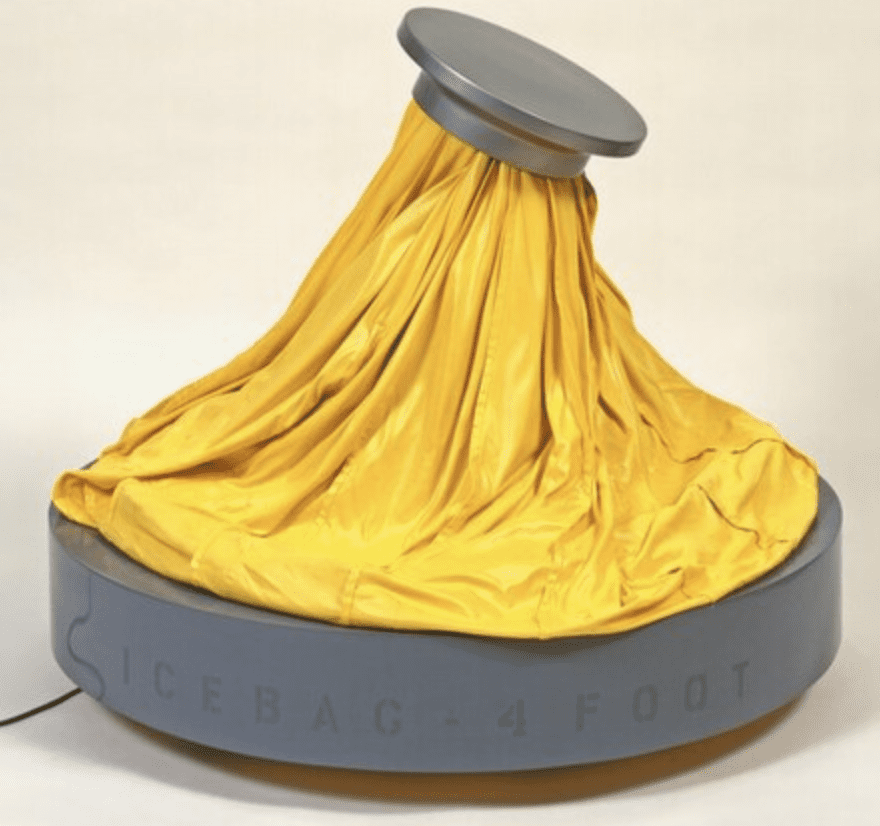
National Gallery of Australia: Claes Oldenburg: Ice Bag Scale B, 1971
Oldenburg produced a limited edition run of “Ice Bag” sculptures in a range of sizes. The NGA ice bag is in the “B” size, with a base approx 1.2 metres in diameter. Rather than being a static display, the cap of the ice bag slowly raises and lowers and rotates, giving the structure a slow gyrating action.
The ice bag was produced before the advent of modern logic based electronic controllers and instead is powered by a series of motors running rack and pinion mechanisms with limit switches that feed a complex electrical relay.
Prior to my work on Ice Bag in 2011, the NGA had little technical documentation on the mechanism inside Ice Bag, and no circuit diagram of the wiring system. A number of important details were known:
-Staff had reported sometimes getting electric shocks when turning off the power switch.
-Many of Oldenburg’s Ice Bag sculptures held in museums and galleries overseas had been destroyed when they caught fire.
Obviously, both of these details were cause of some concern.
Proper technical analysis that looked further than simply hooking the sculpture up to “test and tag” apparatus, but actually sought to understand its wiring and operation fully, revealed important information:
1- When originally wired up to operate in Australia, whoever undertook this work assumed that the white mains wire was active and the black wire was neutral. Unfortunately, in the USA where the work was manufactured, the opposite is the case, meaning that when connecting up the neutral grounded transformer the entire metal chassis of the internal structure of Ice Bag was made live (including the on/off toggle switch). That no-one had been electrocuted previously had been down to purely a matter of luck (and probably rubber soled shoes).
2- Oldenburg’s mechanism used basic limit switches to activate the internal relay and change the direction of the motor driving the rotational movement track when it reached the designed travel limits. Analysis of the circuit showed that when these switches eventually failed (they have a limited number of operations before the contacts wear out), the motor would drive the Ice Bag to the end of the rotation track before jamming, causing the motor to overheat and the structure to potentially catch fire (as had occurred with a number of overseas versions).
To remedy this, all that was necessary was to install two toggle switches wired in series with the mains supply so that if the original travel limiting microswitches were ever to fail and the motor go past it’s designed limits the power would be cut. No change to the operation of the sculpture, no change to the artist’s intent, just an additional level of safety.
Proper understanding of the mechanical and electrical systems of objects like this is key in their preservation if they are to be maintained in an operational state.